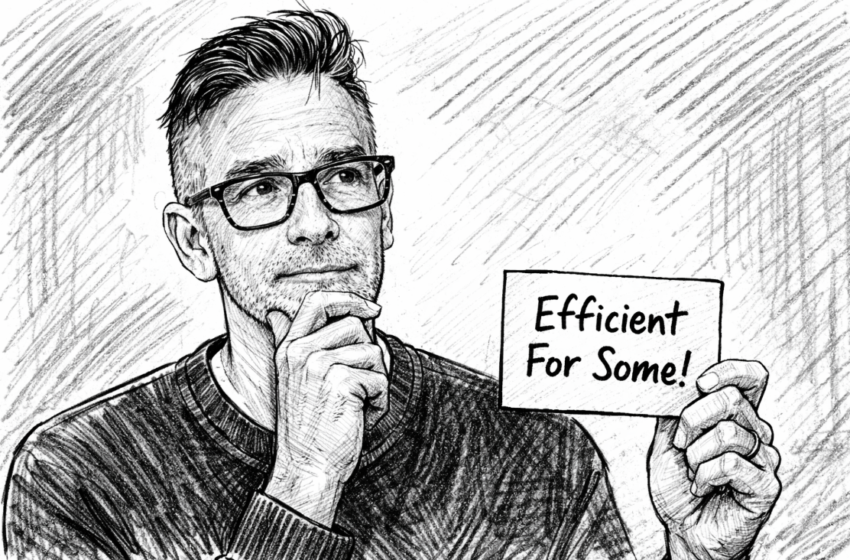
When Your Efficiency Becomes Someone Else’s Problem
I was teaching a project management class when someone shared a story that has stuck with me.
An HR team had redesigned one of their internal processes, which was their prerogative. They had thought it through carefully. They reduced back-and-forth emails, clarified approvals, and eliminated a few bottlenecks that had been slowing them down for months. By their own metrics, it worked. They were saving time each week, and the workflow inside their team was noticeably smoother.
From their vantage point, it was a responsible improvement. Kudos all around!
There was just one complication. The rest of the organization now had about 10% more work to do.
This wasn’t exactly catastrophic, but it became a real pain in the neck for a lot of other people in the company. There was a new system, new request workflows, new invoicing requirements, etc. So, for anyone who had to use this new system from outside the HR team, they weren’t happy. They were annoyed and frustrated, and each person had extra work to do to learn and work in the new system.
What caught my attention wasn’t the frustration itself. It was that the HR team was genuinely surprised by it. They described the pushback as resistance, as negativity. They interpreted the pushback as people being unnecessarily difficult about something that was clearly an upgrade.
So in the midst of my “Intro to Project Management” course, they raised it as a complaint.
So I asked them to pause. I don’t usually dig really deep into personal anecdotes in a course, as we have to keep moving. But this time, I thought we had to deal with it as a classic challenge for projects in many organizations.
I asked them to imagine they were on the other side of the situation.
“If a new system was announced tomorrow and you were simply told to comply, how would that feel?” (I don’t know.)
“What if it added friction to a day that already feels packed?” (I guess I’d not like that.)
“What if you weren’t asked for input before it went live?” (I may feel left out.)
“What if it solved a problem you didn’t think you had?” (Ya, I don’t know)
The discussion shifted a lot at that moment. This “Intro to PM” was now a lot deeper than we expected, as we had a bonafide real example of “what not to do.” I don’t mean to pick on them, but it’s a great experience to learn from. Feelings were hurt, folks were irritated, lessons were learned and things would go much differently next time.
Because this project and the decisions were not about bad intent. It was just that a few steps were missed, hence the Intro to PM course.
Efficiency Isn’t Neutral
In organizational life, efficiency tends to be treated as an unquestioned good. If something saves time or reduces internal friction, we assume it must be progress. If your team can save itself a few hours per week, that’s a good thing. Right?
But efficiency is rarely neutral.
When you reduce friction in one part of a system, that friction sometimes reappears somewhere else. Work does not simply disappear; it can be redistributed.
This idea sits at the heart of systems thinking. Donella Meadows, whose work on leverage points and systemic intervention remains foundational, reminds us that organizations are interconnected systems where actions in one node create effects elsewhere. When we optimize locally without examining the broader system, we frequently create unintended consequences.
The HR team didn’t eliminate the effort. They, well, kinda moved it elsewhere.
From their perspective, the process became leaner and more controlled. From everyone else’s perspective, it became slightly heavier. Both realities were true at the same time.
When we redesign a process, even a modest one, we are intervening in a system of relationships, constraints, and workloads. Systems do not passively absorb interventions. They respond.
Resistance or Just Surprise?
What lingered with me after that classroom conversation wasn’t the mechanics of the process change. It was the emotional gap between what HR expected and what they experienced.
They believed they were delivering an improvement, a new shiny system that would make lives easier. However, the rest of the organization experienced an announcement and a sudden shock about a new process they didn’t ask for and didn’t anticipate.
That gap is where many change efforts begin to falter.
Kurt Lewin’s classic three-stage model—unfreeze, change, refreeze—remains instructive decades later. The “unfreeze” stage emphasizes preparing people for change by helping them understand why it is necessary before the new process is introduced. When that preparation is skipped, even well-designed changes can feel abrupt or imposed.
Similarly, John Kotter’s widely cited research on change leadership argues that successful transformation depends on creating urgency, building buy-in, and communicating vision—not merely implementing new procedures. Change fails less often because the idea is flawed and more often because people were never meaningfully brought along.
In my experience, most resistance is not about the mechanics of a new form or approval step. It can often be about unwelcome surprises.
Even small changes can feel large when they arrive without context. An extra step may represent only a few additional minutes, but symbolically it can signal that decisions are being made without consultation.
The HR team saw efficiency. Others saw additional burden. The missing ingredient was shared understanding.
This Is Project Management
It would be easy to categorize this situation as a communication issue or a people problem.
It is neither, as it’s really about (wait for it…) project management.
Modern guidance from the Project Management Institute (PMI) places stakeholder engagement at the center of professional practice, not at the margins. Identifying impacted groups, assessing influence and interest, and planning proactive engagement are not optional extras reserved for enterprise-scale transformations. They apply equally to internal process redesign.
It’s a hybrid of project management, change management, and stakeholder management (and to be honest, it’s all written plainly in the PMBOK).
If your improvement creates friction for others and you did not anticipate that reaction, the issue is not simply resistance. We are talking about an incomplete stakeholder analysis.
We tend to formalize stakeholder mapping for large, visible initiatives (system implementations, restructures, strategic programs). Yet even modest process adjustments can shift workload, accountability, and effort in ways that matter.
Before rolling out a change, it is worth asking three straightforward questions:
- Who benefits directly from this change?
- Who absorbs additional effort?
- Who did not have a voice in shaping it?
If those answers are unclear, the planning likely is as well.
What Could Have Made This Go Better?
The solution here did not require an elaborate change management framework. It required empathy, applied early.
A short listening session with representatives from impacted teams could have surfaced friction points that were invisible from within HR. A limited pilot might have revealed unintended consequences before organization-wide rollout. Even a candid acknowledgement (“We know this adds a step for you, and here’s why we believe the overall outcome will be worth it”) could have reframed the change as a shared trade-off rather than an imposed burden.
Adults can handle trade-offs, but no one likes being blindsided.
Involving stakeholders does not guarantee universal enthusiasm. It does, however, reduce the sense that change is happening to people rather than with them.
A Simple Test
I often use a simple mental exercise when evaluating process improvements.
Imagine the busiest manager in your organization. The person whose calendar rarely has open space. The person balancing competing priorities daily.
Now imagine them opening an email announcing a new required step in their workflow.
- New fields.
- Additional approvals.
- Revised timelines.
- No prior conversation.
How does that email impact them? Are they thinking to themselves “oh great, a new process!” or are they hanging their head over the keyboard, gritting their teeth?
The HR team in this story was not careless. They were (somewhat) diligent and (definitely) well-intentioned. They improved their process. But they optimized within their own boundaries and were surprised when the wider system reacted.
In complex organizations, that surprise is often the first indication that we have been thinking too narrowly.
References
- Meadows D. Leverage Points: Places to Intervene in a System. The Sustainability Institute; 1999. https://donellameadows.org/archives/leverage-points-places-to-intervene-in-a-system/
- Lewin K. Frontiers in group dynamics. Hum Relat. 1947;1(1):5-41. https://journals.sagepub.com/doi/10.1177/001872674700100103
- Kotter JP. Leading change: Why transformation efforts fail. Harv Bus Rev. 1995;73(2):59-67. https://hbr.org/1995/05/leading-change-why-transformation-efforts-fail-2
- Project Management Institute. A Guide to the Project Management Body of Knowledge (PMBOK® Guide). 7th ed. PMI; 2021. https://www.pmi.org/pmbok-guide-standards/foundational/pmbok