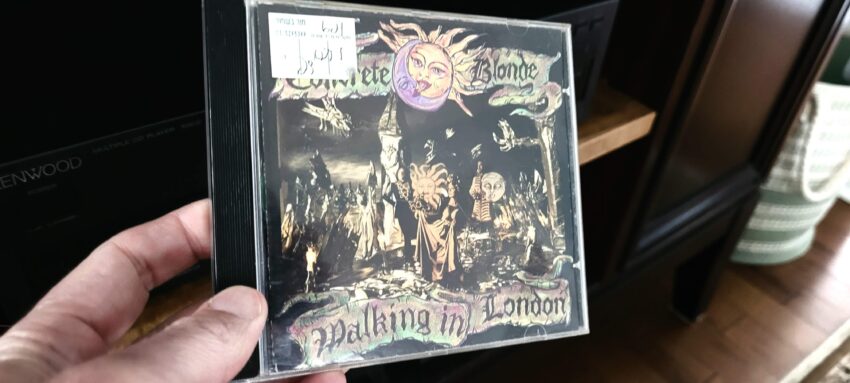
Walking in London (1992) by Concrete Blonde feels like the point where a really distinctive band starts to lose a bit of its center. Not all at once, and not disastrously, but enough that you notice it if you’ve spent time with what came before.
By this point, Johnette Napolitano (vocals, bass), James Mankey (guitar), and Harry Rushakoff (drums) had already established a sound that was hard to confuse with anyone else. There’s a mix of gothic mood, bluesy undercurrent, and straight ahead alternative rock that they locked in on Bloodletting, which still stands as their high point. Mexican Moon, which followed Walking in London, would tighten that identity again in a different, more introspective way. But Walking in London sits in between those two, and it shows.
The title track, “Walking in London,” is the clearest reminder of what the band does when everything clicks. It has that moody, nocturnal feel, carried by Napolitano’s voice, which can shift from restrained to full-on force without sounding like it’s trying. There’s a sense of place in it, but also a sense of dislocation, which is where Concrete Blonde tends to do its best work. It feels intentional, grounded, and emotionally coherent.
But the album does not stay in that lane for long. “Ghost of a Texas Ladies’ Man,” the single, is catchy enough, but it leans into a kind of playful, almost cartoonish storytelling that does not quite land. Borderline silly is fair. It is not that the band cannot have a sense of humor, but here it feels like a tonal shift that never fully integrates with the rest of the record. Instead of adding range, it pulls you out of the atmosphere the album is trying to build.
That sense of drift shows up again with their cover of It’s a Man’s Man’s Man’s World. It is a bold choice, and Napolitano certainly has the voice to take it on. But it ends up feeling more like a detour than a reinterpretation. Where their best material feels internal and lived-in, this track feels external, almost like a band trying something on rather than reshaping it into their own language.
And that is really the throughline with Walking in London. It is not a bad album. There are strong songs, and the musicianship is still there (and to be really fair, Someday is one of the best songs they’ve ever recorded). But overall, the album lacks the cohesion that made Bloodletting so compelling. On Bloodletting, everything points in the same direction. The themes, the tone, even the sequencing all feel aligned. Here, the album moves in a few different directions without fully committing to any of them.
Part of that might be timing. Bands often hit this moment after a breakthrough record where the options open up. You can double down on what worked, or you can stretch out and see what else is there. Walking in London sounds like a band in that second mode, experimenting a bit, not always landing it, but also not playing it safe.
In that sense, it makes Mexican Moon more interesting in hindsight. That record feels more focused again, more deliberate, almost like a response to the looseness here. You can hear them pulling things back together, choosing a lane and committing to it.
So Walking in London ends up as a transitional album. It has flashes of what made Concrete Blonde great, especially in the title track, but it also shows the edges starting to fray. Not a collapse, just a shift. For a band built on mood and cohesion, even a small wobble is noticeable.
I found a copy of the CD on Discogs recently, part of a slow rebuild of my old collection, and it has been fun to have it back in rotation. It sounds good through actual speakers again. Not their high point, but still better than most albums most bands were putting out around that time. That baseline quality says a lot about how good this band was, even when they were a bit off.