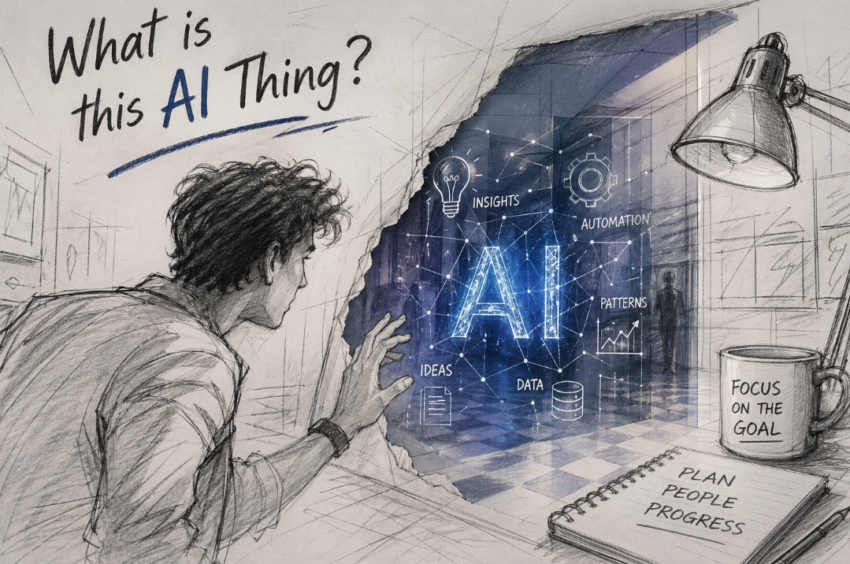
The noise around AI has been insufferably incessant for a few years now. I’ve used the technology, mostly quietly. I’ve watched organizations reorganize themselves around this “new big thing” in real time. Teams expanding, teams shrinking, job descriptions getting rewritten, all orbiting this new gravitational centre called AI.
From where I sit (as a Project Manager with a few decades behind me), the excitement, the panic, all the high emotion doesn’t land quite the same way it might have earlier in my career.
I’ve seen enough cycles to know that when everyone suddenly agrees that this thing changes everything, the truth usually ends up being a little less dramatic, but often more interesting than advertised.
I wasn’t around for the horseless carriage, but I was there for the early internet, the dot-com boom, the bust, the rebuild, Agile becoming something close to religion, and that stretch where every problem could apparently be solved with a new certification. I still remember a stack of AOL CDs sitting in a junk drawer because they felt too important to throw out. Just in case.
So yes, AI is different. It is a transformational technology. It’s already changing how work gets done.
But I’m not losing sleep over it.
That’s probably because project management teaches you, over time, to focus on what actually matters.
It’s not about the tools or the trends or the technology. It’s about the goal.
The job is to build the thing, whatever that thing happens to be, with the people, time, and constraints you have. To make progress when things are unclear. To make decisions without perfect information. To get people moving in roughly the same direction long enough that something real gets delivered.
That hasn’t changed, in my opinion. The goal is still the thing, as it should be.
Which brings me to AI.
For Project Managers, AI isn’t a strategy or a role or a destination. It’s just another tool. A powerful one, yes, but still a tool. Like anything else we’ve picked up over the years, it’s only useful if it helps us get closer to the goal. When people ask how AI will change project management, I think they’re asking the wrong question.
Project management doesn’t change that easily. What does change is the noise and chaos around it.
Most of what PMs do all day lives in language. We listen, we write things down, we translate between groups who don’t quite speak the same dialect. We sit in meetings where something important gets said once, slightly off to the side, and then spend the next few weeks trying to remember exactly how it was phrased.
AI happens to be very good at working with language. Not because it understands projects, it doesn’t, but because we’ve structured our work in ways machines can process. Emails, decks, tickets, chat logs, meeting transcripts. These are the outputs of modern project work.
That’s where AI can actually start to help.
It can take work you’re already doing, summarizing, drafting, spotting patterns, and making the first pass faster. That’s it. And honestly, that’s enough for me.
If you’ve ever come out of a meeting knowing something shifted but couldn’t quite point to where, it can sometimes surface it. If you’ve stared at a blank document even though you know exactly what needs to be said, it can give you something to react to. If a risk has been circling a project without being clearly named, it’s surprisingly good at picking up repetition that’s easy to ignore over time.
None of that replaces good old human judgment. If anything, it puts more pressure on it. Someone still has to decide what matters and what actually gets acted on.
That part is still yours, my Project Management friends.
At home, the stakes are low. You can experiment. Push it a bit. Give it something half-formed and see what comes back. Sometimes it’s impressive. Sometimes it’s confidently wrong. Both are useful to help you learn how to use the tool, and how the tool can serve you.
At work, you need a bit more care, but that doesn’t mean doing nothing.
If your organization allows it and has an approved tool, use it as a second pass. Record the meeting. Review the summary, not to accept it blindly, but to see what it thought was important. Draft the update, then adjust it. Feed in a few weeks of notes and ask what keeps coming up.
It’s not doing the work for me when I do this. It’s helping me organize and see it more clearly.
And it’s worth being clear about what it won’t do.
It won’t resolve conflict or build trust. It won’t spot political landmines. And it won’t save a project with a fuzzy goal or no real sponsorship. Those human missiles will still sink the ship if not handled properly.
If anything, it makes disengagement more obvious. PMs who stop thinking because a tool exists are going to struggle. PMs who stay curious and selective will be fine.
Which brings us back to the goal.
The real risk with AI isn’t that it’s too powerful or too disruptive. It’s that it becomes another thing people either chase or ignore completely. Project management has never benefited much from either extreme. Good PMs know when to aim right down the middle.
You don’t need to reinvent how you work. You don’t need to keep up with every update. You just need to understand this tool well enough to know when it reduces friction and when it doesn’t.
If it gives you back time to think, to notice, to lead, use it.
If it doesn’t, then you can leave it alone.