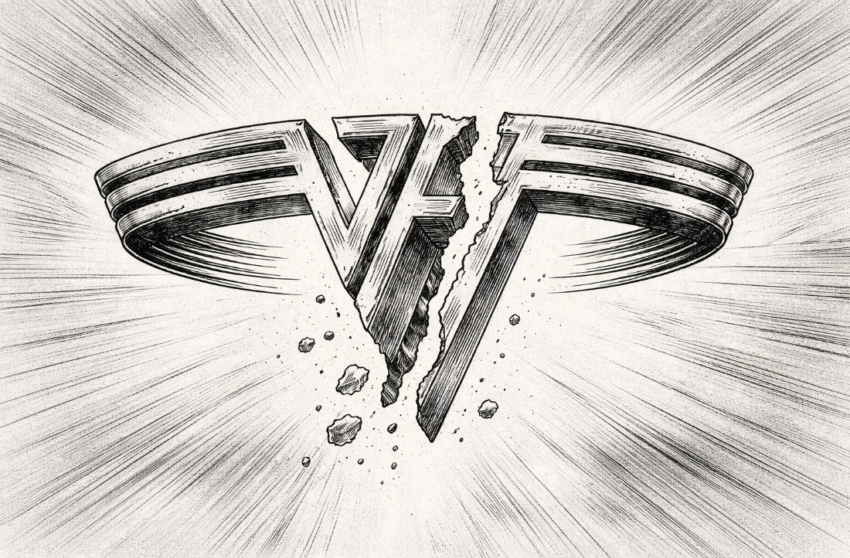
It was 1985, just like in the song from Bowling for Soup, and we were all wondering who the new guy in Van Halen was going to be.
It is very hard to explain the importance of this moment in our young lives. Mostly because, in the greater context of the planet, with all its injustices and wars and struggles, we were 100% oblivious to everything. All of it.
Ethiopia? What? Cold War? What’s that?
The only thing on our radar was this:
How would Van Halen replace David Lee Roth?
I recognize now that’s true of a lot of 12-year-old kids. Especially ones living a life of relative comfort in a small town in Southwestern Ontario. We got our news from nowhere. We developed our priorities from Detroit rock radio and the fledgling days of MuchMusic, where music videos and rock star interviews shaped our tastes week after week after week.
No band of the era impacted our irreverence and social irrelevance quite like Van Halen. This is not a dig at the band. They were incredible musicians, songwriters, and entertainers. They deserved the attention. It’s just amusing to me now, looking back, and realizing that World War III could have broken out and I would have been more intrigued by rumours of new singers coming into the band.
Pre-internet, sleuthing on these things was a challenge. If there were auditions, fans wouldn’t know about them for months, or years, or ever. And then one day, news started stretching across the radio waves, printed pages, and technicolour TV that Sammy Hagar got the gig.
We knew Sammy. He was great. His most recent hit, I Can’t Drive 55, was about as “rebellious” a message as we had ever heard. I mean, c’mon, this guy just wants to live his life and drive a bit over the speed limit. Why was The Man holding him back? He needs to drive maybe 58 or 60, 65 tops. Let the guy be free!
In later years, through maturity, reading, and the discovery of punk rock and hip hop, my understanding of what art was (and what inspired it) would deepen. But at 12, hidden from the real world, I just couldn’t believe the great injustice Mr. Hagar was talking about. Speed limits, clearly designed by square bureaucrats, should have been a greater priority in public discourse. 55 indeed. What the hell were they thinking?
Once the rumours were confirmed, the debates started. They still continue, with some vigour, in various dark and dusty corners of the internet.
David Lee Roth was Mr. Personality, a wild entertainer with his tongue always firmly in cheek. Parties seemed to erupt around him. He could get audiences to do anything.
Hagar? He was clearly not a fit for a party band that knew how to have a good time. He might end up in jail from speeding, and then what would the band do? Would Dave be willing to come back and do his old bandmates a favour once in a while if the dangerous Hagar was locked up for telling The Man that now he couldn’t even drive 60 mph? My God, what if it went to 70? The man was too much of an uncontrollable badass to handle the constraints of a full-time rock and roll party band.
These were real concerns.
Rumours swirled for months. We were all dying to hear what this new Van Halen would sound like. All of us, friends, cousins, schoolmates, spent countless hours lip-syncing to Jump, Panama, Dance the Night Away. Van Halen (avec Roth) was the heart pumping blood through our veins. We were genuinely worried that this new version (sans Roth) might stop it cold.
And then Detroit rock radio came through.
A new Van Halen (avec Hagar) single was coming. They’d play it for the first time at noon on Sunday, March 24, 1986.
My brother and I gathered around our small Realistic radio/cassette player at 11:30 a.m. and waited.
Noon came.
And then… the stupid, dumb, lame, way-too-long commercial break. (Adult me still wonders how much Carl’s Deli in Ypsilanti paid for that 30-second spot.)
Finally, the DJ came back on and said what we were dying to hear:
“Ok Van Halen fans, here it is…the new single from Eddie, Alex, Michael and Sammy…this is Why Can’t This Be Love.”
A subtle percussive synth. A hint of Jump…and then, umm… more synth. Some guitar chords in the background, but this was not a guitar-heavy song. It was pop at best. Not rock. Not heavy. And definitely not Dave.
Once we got to the chorus, battle lines were drawn.
No discussion. No coordination. Not a single tweet to guide us through the chaos. Monday morning, the entire schoolyard split instantly into two camps.
Camp #1: Loving this Hagar thing. Song rocks.
Camp #2: They suck now. Full stop.
Families divided. Friend groups fractured. Teenage lovers turned on each other, relationships ended. New alliances formed.
This was the end of days.
Funny now, of course, how that seemed like a big cultural moment. Big dumb rock music was part of the culture, of course. But this wasn’t exactly the kind of seismic shift the 80s became known for (Berlin Wall, collapse of the USSR, etc.).
No real bullets fired, no one died because Eddie and Dave hated each other. They carried on, as we all did. Now, this “big deal” is quaint and the stuff of warm nostalgia.