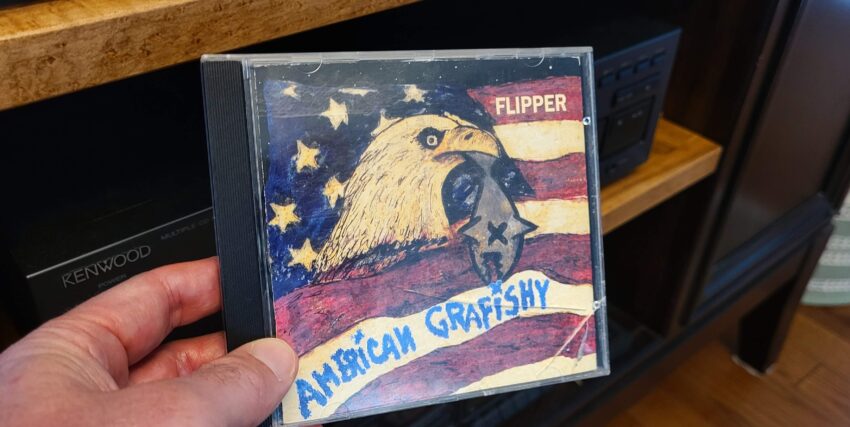
There was never a universe where Flipper were going to become commercially successful. Even at their most accessible, they sounded like a band actively resisting the idea of popularity. Slow, ugly, repetitive, sarcastic, deliberately uncomfortable, and seemingly allergic to anything resembling conventional punk energy, Flipper made music that felt designed to clear rooms instead of fill them. Which is exactly why American Grafishy remains such a fascinating record.
Released in 1993 on a major label of all things, American Grafishy stands as one of the strangest label decisions of the early 90s alternative boom (kudos to Rick Rubin for giving them a shot). This was the era where major labels were desperately throwing money at anything remotely connected to underground credibility. Nirvana had exploded, punk was suddenly marketable again, and executives convinced themselves that the next big thing was probably lurking somewhere in the American indie underground. Somehow, somebody looked at Flipper and thought, “Yes, this is a band that can move units.”
That idea is hilarious even now.
Flipper were never going to be Green Day. They were never even going to be Sonic Youth-level successful. Their entire identity was built around discomfort and anti-commercialism. Their songs stagger instead of sprint. The riffs crawl forward like they are half sedated. Vocals sound less like performances and more like exhausted people yelling from the back of a collapsing basement party. Even when they aim for hooks, the hooks arrive covered in grime and bad intentions.
And yet, American Grafishy is probably as close as Flipper ever came to making a “pop” record. The best example is the remarkable Flipper Twist, which both uses and mocks an old reliable pop structure: The Twist.
The production is cleaner than their early material, the songs are tighter, and there are actual moments where you can hear the band flirting with accessibility. At least by Flipper standards. Tracks still lurch and wobble with that signature burned-out nihilism, but there is a little more structure holding things together this time around. The grooves feel more deliberate, the noise slightly more controlled. If Generic Flipper was the sound of total collapse, American Grafishy feels like the hangover afterward.
That does not mean the band suddenly became easy listening. This is still deeply weird music. The bass remains massive and ugly, the tempos stay stubbornly slow, and the whole album radiates the same damaged energy that made Flipper influential in the first place. You can hear why bands from grunge, noise rock, and sludge metal worshipped them, even if regular listeners probably wondered what the hell they were hearing.
What makes the album work is that Flipper never sound like they are compromising. Even on a major label, they still sound fundamentally uninterested in giving audiences what they want. There is something admirable about that level of stubbornness. Most bands soften their edges when bigger money arrives. Flipper just delivered a slightly shinier version of the same wonderfully broken music they had always made.
Revisiting American Grafishy now also hit me at the perfect time because I was ridiculously happy to finally see Album – Generic Flipper get properly reissued. That album disappearing from vinyl for years felt wrong considering how important it is to punk and noise rock history. Being able to finally grab a copy and complete my Flipper vinyl collection honestly felt weirdly satisfying. Few bands deserve preservation more than Flipper, precisely because nobody else ever sounded remotely like them.
American Grafishy may have been the closest Flipper ever came to accessibility, but thankfully they still sounded far too strange to ever truly fit into the mainstream.